Showing posts with label Guatemala. Show all posts

Tuesday, September 12, 2017

Seize and Send v. Investigate and Indict: Focusing on Cultural Heritage Criminal Investigations and Prosecutions

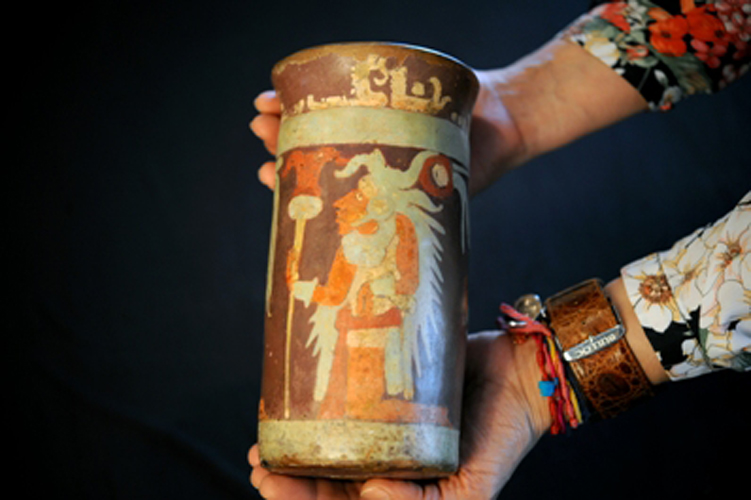
ICE and CBP return an illegally
imported artifact to Guatemala.
Courtesy ICE.
Immigration and Customs Enforcement (ICE) and Customs and Border Protection (CBP) held a press conference on February 24 to publicly display the return of pre-Columbian objects to the Guatemalan foreign minister. The objects were recovered both in Houston, Texas in 2009 and from an auction house in Massachusetts in 2011. WJZ television in Baltimore reported that “[n]o arrests in the smuggling cases have been made, although federal agents say investigations are ongoing.”

Authorities are to be lauded for detecting and seizing illegally imported archaeological objects. But the claim that federal officials are continuing their investigation remains to be seen. That is because the primary evidence of possible smuggling has now been returned to Guatemala. The artifacts are no longer preserved for criminal analysis, they are not kept in safekeeping for use in court proceedings, and they are not available for inspection by potential criminal defendants who have a constitutional right to view the government’s evidence in a criminal case.

There appears to be no US Attorney involvement in this case, which is a sign that the matter likely is not being reviewed for possible criminal charges. And Homeland Security does not mention in its official press release that it is pursuing a criminal investigation. At best the agency cautions that “[t]hose involved in the illicit trafficking of cultural property, art and antiquities can face prison terms of up to 20 years, fines and possible restitution to purchasers of the items.“

Those who follow cultural property cases closely are aware that Homeland Security generally implements a seize and send policy with regard to cultural artifacts. While the agency boasts in its latest press statement and elsewhere that “[s]ince 2007, HSI [Homeland Security Investigations] has returned more than 2,500 artifacts to 23 countries …”it is silent about successful cultural property prosecutions. Such prosecutions are rare.

The Cultural Property, Art and Antiquities Investigations Program is carried out by HSI. The agenda describes its mission on ICE’s web site: “Returning a nation’s looted cultural heritage or stolen artwork, promotes goodwill with foreign governments and citizens, while significantly protecting the world’s cultural heritage and knowledge of past civilizations.” The emphasis is on sending cultural objects to home countries, not on developing cases for criminal prosecution.

It could very well be that the lack of financial or human resources prevents the development of cultural property smuggling cases. It could be too that politics affects agency decision making. Indeed, it may be noteworthy that on the same day of the repatriation of artifacts to Guatemala, Homeland Security Secretary Janet Napolitano announced that she would be traveling to Guatemala City and other Latin American destinations between February 27 and 29. Perhaps prosecutors are rejecting these cases for review. Whatever issue prevents ICE from doing its job to investigate and prepare cases for presentation to a federal grand jury and subsequent criminal prosecution must be resolved.

ICE Director John Morton is right to note “the exceptional investigative work HSI is doing to stop the pilfering and illicit trading of precious art and antiquities from around the world.” ICE has talented investigators. But more must be done to bring the talents of these federal agents to the next level so that their cases serve to provide a meaningful deterrent to archaeological smuggling. Investigators must be permitted to conclude their cases by submitting them to receptive US Attorneys for review and possible indictment. Cases concluded through seizure, forfeiture, and repatriation alone do not have a similar impact on criminal activity.

Sources:
Homeland Security press releases
http://www.ice.gov/news/releases/1202/120224washingtondc.htm
http://www.dhs.gov/ynews/releases/20120224-statement-on-napolitano-trip-to-central-america.shtm

WJV TV
http://baltimore.cbslocal.com/2012/02/24/stolen-ancient-mayan-artifacts-being-returned-to-guatemala/

CONTACT: www.culturalheritagelawyer.com

Sumber http://thetrialwarrior.blogspot.com/

Mali, Guatemala, and Bulgaria Up for Discussion by CPAC - Public Session Slated for April 24

earlier request for a bilateral agreement.  That session, according to the Federal Register, will be a confidential meeting authorized by 19 U.S.C. 2605(h), which permits private discussions when "the President or his designee [determines] that the disclosure of matters involved in the Committee’s proceedings would compromise the government’s negotiation objectives or bargaining positions on the negotiations of any agreement authorized by [the CPIA]."

An MoU or bilateral agreement protecting jeopardized archaeological and ethnological objects may be enacted between nations pursuant to Article 9 of the 1970 UNESCO Convention (the Convention on the Means of Prohibiting and Preventing the Illicit Import, Export and Transfer of Ownership of Cultural Property). Congress implemented the treaty by adopting the Cultural Property Implementation Act (CPIA), signed into law by President Ronald Reagan in 1983.  Import protections granted under the CPIA last for five years and may be renewed thereafter.

Head of a Mali figure.
Source: US Department of State.
The United States enacted emergency import controls in 1993 over archaeological material from Mali's Niger River Valley and its Tellem burial caves at Bandiagara. This action led to the 1997 adoption of an MoU between the two nations.  The bilateral agreement was then extended in 2002 and 2007.  The last MoU was broadened to include archaeological objects from the Stone Age to the 1700s.

The United States also took emergency action in 1991 to cover Maya archaeological artifacts from Guatemala's Petén region, extending the protections in 1994.  In 1997, the U.S. and Guatemala entered into a bilateral agreement covering pre-Columbian archaeological material.  The countries extended the MoU in 2002 and 2007.  The 2007 MoU broadened Article 2's provision to include, among among other items, that "the Government of the Republic of Guatemala shall undertake an assessment with regard to improvements in broad areas such as law enforcement, cultural resource management, education, conservation, research, and the national museum system" before the agreement expired in 2012.

To attend or speak at the public session on April 24, you may reserve your place by calling  the Cultural Heritage Center of the Department of State at (202) 632–6301 by 5 p.m. EDT on April 3.  The meeting will be held at 2200 C St., NW. in Washington, DC.

Public comments may be submitted electronically to CPAC at www.regulations.gov and are due April 3 by the end of the day.  Enter docket number DOS-2012-0012 for Mali or docket number DOS-2012-0011 for Guatemala and follow the instructions on the web site.

The committee now only accepts electronic comments unless they are confidential under 19 U.S.C. 2605(i)(1).  Written submissions reasonably determined to qualify for confidentiality may be delivered or mailed to:

Cultural Heritage Center (ECA/P/C)
SA-5, Fifth Floor
Department of State
Washington, DC 20522-0505

Comments submitted to CPAC must address one, some, or all of the four determinations outlined by the CPIA.  Quoting 19 USC 2602, the four determinations are:

(A) [whether] the cultural patrimony of the State Party is in jeopardy from the pillage of archaeological or ethnological materials of the State Party;

(B) [whether] the State Party has taken measures consistent with the Convention to protect its cultural patrimony;

(C) [whether] --

(i) the application of the import restrictions . . . with respect to archaeological or ethnological material of the State Party, if applied in concert with similar restrictions implemented, or to be implemented within a reasonable period of time, by those nations (whether or not State Parties [to the 1970 UNESCO Convention]) individually having a significant import trade in such material, would be of substantial benefit in deterring a serious situation of pillage, and

(ii) remedies less drastic than the application of the restrictions set forth in such section are not available; and

(D) [whether] the application of the import restrictions . . . in the particular circumstances is consistent with the general interest of the international community in the interchange of cultural property among nations for scientific, cultural, and educational purposes.

Tomorrow's Federal Register announcement of the CPAC meeting may be found here.


Sumber http://thetrialwarrior.blogspot.com/