Tuesday, September 12, 2017

US Supreme Court Rules Against Odyssey Marine's Request for Stay


Associate Justice Clarence Thomas
 The US Supreme Court has denied Odyssey Marine Exploration's application for a stay pending the filing and disposition of a petition for a writ of certiorari (i.e. a request to have the court review the case). Justice Clarence Thomas ruled on the matter today, docketed at 11A745.

Days ago the eleventh circuit court of appeals ruled in the case of Odyssey Marine Exploration, Inc. v. Kingdom of Spain, et al. that Odyssey could not postpone the return of the so-called Black Swan treasure to Spain while the commercial salvor appealed the case to the nation's highest court. Odyssey took the items from a Spanish galleon--the Nuestra Senora de las Mercedes--that sank in 1804 and was discovered in 2007.  Spain has contended that the galleon is a Spanish warship subject to protection from salvage.

On February 3, attorneys for Odyssey Marine filed their application to stay the court of appeals' decision.  The supreme court's denial followed on February 9.

CONTACT: http://www.culturalheritagelawyer.com/

Sumber http://thetrialwarrior.blogspot.com/

Lost in Translation: A Defendant’s Rights to Counsel

Under the Fifth and Sixth Amendments, a criminal suspect is guaranteed the right to counsel.  But there’s a difference between what the two amendments provide.  The Fifth Amendment right to counsel was created by the Supreme Court decision in Miranda v. Arizona, where the Court held that a person has the right to have counsel present during custodial interrogation (interrogation counsel).  The Sixth Amendment guarantees a defendant the assistance of counsel for his defense at trial (trial counsel).
Over the past four decades, the jurisprudence concerning the Fifth Amendment right to counsel during police interrogation (interrogation counsel) and the Sixth Amendment right to counsel at all critical stages of criminal proceedings (trial counsel) had become intertwined in complex and confusing ways. It was increasingly difficult for courts to determine which right can be invoked when and whether invocation of the right to counsel under one amendment invoked the right to counsel under the other amendment.
Pecina v. State, a recent Texas Court of Criminal Appeals case, illustrates the confusion that existed between the two rights to counsel.  In Pecina, Arlington Police officers arrested the defendant for the murder of his wife and took him to the hospital rather than the jail because he had suffered significant stab wounds (allegedly self-inflicted).  Because Mr. Pecina could not be transported to see a magistrate within 48 hours as required by the Texas Code of Criminal Procedure, the police officers brought a magistrate to him.  A bilingual magistrate.  The magistrate advised Mr. Pecina (in Spanish) of his Article 15.17 rights including, inter alia, the right to have an attorney present throughout the criminal trial process (i.e. trial counsel – 6th Amendment).

“After reading appellant his rights, [the magistrate] asked if he wanted a court-appointed attorney.  And he stated that he did.” She then asked Mr. Pecina if he “still wanted to talk to [the detectives]?” He said that he did.  The magistrate (as she later testified) believed that, when Mr. Pecina asked for counsel, he was asking for trial counsel, not interrogation counsel.  The two detectives then entered the hospital room and issued Mr. Pecina his Miranda warnings (in Spanish).  Mr. Pecina waived his Miranda rights, did not request an attorney, and gave a statement.  He was later convicted for murder after his statements to the detectives were admitted against him at trial.

These facts raise important questions:
When Mr. Pecina told the magistrate that he wanted a court-appointed attorney, did he invoke his rights under both the 5th and 6th Amendments? Should the police have refrained from initiating further questioning until he had an attorney present?
Prior to the 2009 Supreme Court decision in Montejo v. Louisiana, 556 U.S. 778, the controlling case regarding the two intertwining rights to counsel was Michigan v. Jackson, 475 U.S. 625 (1986). “In Michigan v. Jackson, the Supreme Court had held that ‘if police initiate interrogation after a defendant’s assertion, at an arraignment or similar proceeding, of his right to counsel, any waiver of the defendant’s right to counsel for that police-initiated interrogation is invalid.’"

Under Michigan v. Jackson, Mr. Pecina’s assertion of his right to counsel that he made to the magistrate in the hospital would have been enough to preclude the police from initiating further interrogation. Or, if the police did later initiate interrogation, any statement Mr. Pecina made should have been suppressed at trial.

But all of that changed under Montejo in 2009. In Montejo, the Supreme Court disentangled the right to interrogation counsel with the right to trial counsel.
Distilled to its essence, Montejo means that a defendant’s invocation of his right to counsel at his Article 15.17 hearing says nothing about his possible invocation of his right to counsel during later police-initiated custodial interrogation. The magistration hearing is not an interrogation event.
Analyzing the Pecina case in the wake of Montejo, the CCA explained that “[i]n this case, there were two separate events: magistration followed by a custodial interrogation.” The CCA then held that “under the totality of the circumstances…an objective and reasonable police officer, conducting a custodial interrogation would conclude that appellant had voluntarily waived both his Fifth and Sixth Amendment rights to counsel for the purposes of custodial questioning.”

The CCA went further to clarify the new rule, explaining that under the Supreme Court decisions in Montejo, Miranda, Edwards, and Minnick, a suspect’s Fifth Amendment rights (to interrogation counsel) are only triggered “AFTER THE POLICE INFORM HIM OF HIS RIGHT TO COUNSEL AT THE BEGINNING OF A CUSTODIAL INTERROGATION.” Emphasis added.  Ultimately, the CCA held that the magistration hearing (in which Mr. Pecina requested an attorney) did not trigger any Fifth Amendment right concerning custodial interrogation; that, the CCA explained, was done by the detectives at the beginning of their interrogation.

PRACTICE NOTE: A criminal defendant/suspect must now request an attorney, unequivocally, at every stage of the criminal justice process.  Interrogation.  Arraignment.  Magistration.  Every stage.  This is a significant change in Texas criminal procedure.

Judge Alcala joined the majority opinion but wrote a separate concurring opinion, in which she notes:
The magistrate’s interpretation (that Mr. Pecina only requested trial counsel and not interrogation counsel) misses the whole point of the warning, which is the right to have an attorney present ‘during any interview with peace officers.’ I conclude that the record indisputably shows that appellant’s request for an attorney was a request to have an attorney present during interrogation, as well as during court proceedings. …Appellant’s request for an attorney was, at most, a pre-invocation of his right to counsel.
Judge Alcala believes that the “Legislature could easily fix [the confusion between the two rights to counsel] by adding one sentence to the Article 15.17 admonishments: ‘If you desire to have an attorney present during police interrogation, you must make that request at the time of the police questioning.’”

Judge Price dissented, opining that “[a]ny reasonably objective viewer would conclude from the peculiar facts of this case that [the magistrate] was acting as a de facto agent of the interrogating detectives." He went further:
That the invocation [of Mr. Pecina’s rights] also occurred during a simultaneous “magistration,” while accurate, does not detract from its essential character for Fifth Amendment purposes. And once a suspect has made it clear that he desires the assistance of counsel in coping with police interrogation, we are not entitled to look at his subsequent responses to official entreaties “to determine in retrospect whether the suspect really meant it when he unequivocally invoked his right to counsel.”
Judge Price believes that Mr. Pecina's Fifth Amendment right to interrogation counsel was violated.  I agree.
Sumber http://thetrialwarrior.blogspot.com/

State Department Gives Seizure Immunity to Cultural Objects from Kazakhstan


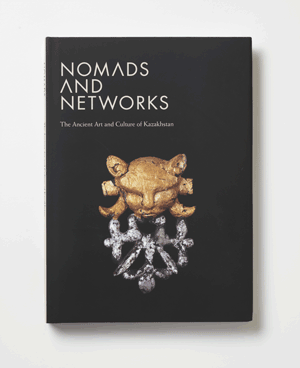
The State Department’s Bureau of Educational and Cultural Affairs has granted cultural objects from Kazakhstan immunity from judicial seizure.  The protected pieces will be part of a 2012 exhibition called “Nomads and Networks: The Ancient Art and Culture of Kazakhstan.”

The exhibit is to be held at the Institute for the Study of the Ancient World at New York University from March 6, 2012, to June 3, 2012.  The exhibition catalog describes a presentation of cultural objects from the sixth to the first century BC, including saddles, objects from the Berel valley, and gold mortuary ornaments from Shilikty and Kargali.

Under the federal statute known as Immunity from Seizure Under Judicial Process of Cultural Objects Imported for Temporary Exhibition or Display (22 USC § 2459), foreign lenders are encouraged by Congress to lend cultural objects to museums without risk that those objects will become targets of litigation while on American soil.  The statute protects imported objects determined to be (1) of cultural significance, (2) intended for temporary, nonprofit exhibition, and (3) in the national interest.

Museums importing objects for temporary display must apply for this legal protection.  The notice of immunity is then published in the Federal Register.


Sumber http://thetrialwarrior.blogspot.com/
Ivory Smuggling Case Moves Forward

Agents arrested him in July.  A person indicted is presumed innocent unless prosecutors prove guilt beyond a reasonable doubt in a court of law.  

The Lacey Act 16 USC 3371 et seq. protects wildlife and other natural resources. Under the law, it is illegal to import, transport, sell, receive, acquire or purchase specified wildlife taken, possessed, transported or sold in violation of any law, treaty or regulation of the United States.

The indictment also cites the Endangered Species Act 16 USC 1531 et seq., which makes it illegal to possess or trade illegal African ivory under the Convention on International Trade in Endangered Species of Wild Fauna and Flora (CITES). Legal import into the United States only occurs when a person obtains an import permit plus a foreign export permit issued by the country of origin or a foreign re-export permit issued by the country of re-export.

The indictment alleges that between 2006 and 2009 Gordon paid a person to travel to Africa on multiple occasions to "purchase raw elephant ivory and have it carved to Gordon's specifications. In advance of each trip, Gordon provided [the person] with photographs or other depictions of ivory carvings to serve as templates. Gordon also directed [the person] to stain or dye the elephant ivory specimens so that the specimens would appear to be old."  The ivory was brought through JFK International Airport in New York inside luggage before being sold by Gordon at his store in Philadelphia.

Federal prosecutors seek criminal forfeiture of the items seized. Specifically, they seek cash and objects that include nearly 500 ivory tusks and carvings seized between 2009 and 2010 in Pennsylvania, New York, Missouri, Kansas, Florida, and California.

If convicted, Gordon could face up to 20 years in prison.

CONTACT:
www.culturalheritagelawyer.com
Sumber http://thetrialwarrior.blogspot.com/

ACCG Makes Allegations in Baltimore Coin Case Reply Brief

the brief by federal attorneys last month. The court case first started when the ACCG imported ancient Chinese and Cypriot coins through Baltimore, Maryland without a permit in an effort to challenge import protections put in place by the Cultural Property Implementation Act (CPIA).  The case is now on appeal in the Fourth Circuit after the ACCG lost in the lower federal district court.

The judiciary possesses the authority to review implementation of import controls over listed Chinese and Cypriot ancient coins coming into the United States. That is what the ACCG contends in its legal brief.  The organization summarizes its position in the argument title: "The District Court Possessed Ample Authority to Review the Government's Decision to Impose Import Restrictions on Collectors' Coins."

The group casts the controversy as a contest between "collectors' coins," which are of interest to the organization's small numismatic businesses and hobbyists, versus "serious substantive and procedural irregularities" on the government's part.  It complains that "[t]he Government … insists that its efforts to suppress the long-standing trade in common collectors' coins is either a foreign policy matter or one fully committed to agency discretion, leaving the Guild and the small businesses and collectors it represents without recourse." The group challenges authorities who believe they are "empowered to seize any undocumented coin that 'likely' was found in either Cyprus or China, notwithstanding explicit statutory language [in the Cultural Property Implementation Act] to the contrary."

The ACCG's brief levels "serious allegations," claiming that US State Department staff "worked behind-the-scenes with members of the archaeological lobby to orchestrate a change in existing precedent exempting coins from import restrictions ...." and that "staff added coins to the Chinese import restrictions without a formal request from Chinese officials."  The ACCG also alleges that an undersecretary of state "ordered [Cypriot] import restrictions … as a 'thank you' to Greek and Cypriot-American advocacy groups which had given him an award" and that an assistant secretary of state "did not recuse herself from approving the 2007 extension of the Memorandum of Understanding (“MOU”) with Cyprus after she had accepted a new position with an international financial institution that likely has business interests with Cyprus …."  The group additionally claims that the "State [Department] then misled Congress and the public about CPAC's true recommendations against import restrictions on coins."  CPAC is the Cultural Property Advisory Committee that advises the president about adopting import controls over cultural property in jeopardy from pillage.

The ACCG's brief further "alleges that the Government: (1) confused 'cultural significance' with 'archaeological significance' when it comes to objects that exist in multiples, like coins; (2) ignored evidence that Cypriot and Chinese coins circulated widely beyond their place of manufacture such that the 'first discovery requiremen'’ could not be met; (3) ignored or misapplied the CPIA’s requirements that less drastic measures like treasure trove laws or regulation of metal detectors be instituted before imposing restrictions; (4) ignored or misapplied the CPIA's 'concerted international response requirement;' and (5) wrongfully imposed import restrictions on coins without regard to their find spots."

The group argues that "the court has an obligation to ascertain whether coins were properly designated for restriction." That is, in part, because "CBP [Customs and Border Protection] acted in an arbitrary, capricious, or illegal manner under the APA [Administrative Procedures Act] when it allowed [the] State [Department] to assume authority over the preparation of the designated [import control] List."

The ACCG contends that it took action in court, not because it did not follow the rules as federal lawyers assert, but because the federal government failed to file a forfeiture action. The organizations says in its brief that the "Government’s claim that a forfeiture action provided an adequate remedy for the Guild borders on the Kafkaesque."

Note: Citations of authorities contained in the original ACCG brief are omitted from the quotes above.

CONTACT:
www.culturalheritagelawyer.com
Sumber http://thetrialwarrior.blogspot.com/

CCA Holds: Medical Care Defense Not Limited to Medical Personnel

Texas Penal Code Section 22.021(a) provides that a person commits aggravated sexual assault if the person intentionally or knowingly causes the penetration “by any means” of the anus or sexual organ of a child younger than 14 years of age. Section 22.021(d) provides that “it is a defense to prosecution…that the conduct [constituting the offense] consisted of medical care for the child and did not include any contact between the anus or sexual organ of the child and mouth, anus, or sexual organ of the actor[.]

During the trial of Walter Cornet, for the alleged aggravated sexual assault of his eight year-old step-daughter, the defendant sought to use the medical care defense. The defendant alleged that after his step-daughter complained to him that her older brothers had had sex with her, he, acting as a parent, conducted an examination of her genitals (anus and labia) using his fingers. The trial court refused to instruct the jury on the medical care defense. The defendant was convicted.

On appeal to the 8th District Court of Appeals (El Paso), the Court affirmed the conviction and held that:
the [medical care] defense “is not meant to apply…in cases…when the parent suspects his child has been sexually abused and proceeds, without any medical education, training, or experience, to examine the area.”
The Texas Court of Criminal Appeals accepted appellant’s petition for discretionary review to settle the issue. Can a parent, untrained in the medical field, claim the medical care defense, under Section 22.021(d) of the Texas Penal Code? The CCA said YES and overturned the 8th Court’s decision.

Writing for a 5-4 majority (on this issue only), Judge Price explained:
The text of the statute makes it abundantly clear that it is the nature of the “conduct,” not the occupation of the actor, that characterized the availability of the defense. Nowhere in [Section 22.021(d)] is there any mention or suggestion that the availability of the defense is limited to health-care professionals; and for this Court of read such a restriction into the defense would impermissibly “add or detract from [the] statute.”
The CCA remanded the case to the lower court to conduct a harm analysis.

Judge Cochran dissented. She states that “[w]hen asserting a ‘medical care’ defense, the defendant bears the burden of offering some evidence that his conduct was, in fact, a legitimate, accepted medical methodology.” She goes on to note that:

[i]f this [procedure performed by appellant] meets any common-sense description of accepted or acceptable medical care, the children of Texas are in big trouble. Never mind that there was not a scintilla of evidence that appellant had any medical training, medical expertise, or that this “home exam” methodology was accepted by any medical provider anywhere as an acceptable one. There is no legal defense to sexual assault for a step-father, fried, priest, or big brother to “check-out” the situation by penetrating the anus and genitals of a child because that child had told him that she had had sex with anyone.
Judge Cochran believes that appellant’s defense fails as a matter of law.
Sumber http://thetrialwarrior.blogspot.com/

The Booking-Question Exception: Another Reason to Shut Up

Alford v. State - (Tex. Crim. App.) Feb. 8, 2012

Cecil Edward Alford was charged with evading arrest and detention.  While being transported to jail, Officers noticed that Mr. Alford was squirming around in the back seat.  Once at the jail, officers got Alford out of the car and searched the back seat.  As was procedure, they had searched the back seat of the squad car before their shift started to confirm that there were no items in the back seat.  After searching the back seat of the squad car following Mr. Alford’s transport to jail, officers located a clear plastic bag with pills inside and, directly under the bag, a computer flash drive (“thumb” drive).  As the jailers were booking Alford in, one of the officers took the thumb drive and held it up to Mr. Alford asking what it was.  The officer then asked, “Is it yours?” Alford claimed that it was.  At the time the jailer asked the question, Alford had not been advised of his Miranda rights.

The legal question arising from this situation is whether Alford’s admission that he owned the flash drive could be used against him at his trial.

The Court of Criminal Appeals first analyzed this case by addressing custodial interrogation and the “booking-question exception” to Miranda.  The Court recognized that questions “normally attendant to arrest and custody” or “routine booking questions” are exempt from Miranda. See South Dakota v. Neville, 459 U.S. 553 (1983); Pennsylvania v. Muniz, 496 U.S. 582 (1990).  The CCA noted that Mr. Alford’s case hinged on whether the question that the officer asked him that night was reasonably related to administrative concerns or if it was a question designed to elicit incriminatory admissions.

The defense presented case law supporting the contention that a question does not necessarily fall within the booking-question exception to Miranda simply because the question was asked during the booking process.  Specifically, the defense cited a footnote at the end of the Supreme Court’s opinion in Muniz that said, “recognizing a ‘booking exception’ to [Miranda] does not mean, of course, that any question asked during the booking process falls within that exception.  Without obtaining a waiver of the suspect’s [Miranda] rights, the police may not ask questions, even during booking, that are designed to elicit incriminatory admissions.” Id at 602, n. 14 (Brennan, J., plurality op.)

The CCA conceded that case law actually supported both the State and the appellant in this case.  Ultimately though, the Court held that the booking-question exception applies when the question reasonably relates to a legitimate administrative concern regardless of whether officer should have known that it might elicit an incriminatory admission.  The Court held that the Officer’s question in Alford’s case had the legitimate interest of identification and storage of an inmate’s property and that the questions regarding the thumb drive did fall within the booking exception to Miranda.

Essentially, the court decided that the relationship between the officer and Alford was not the determining factor.  Even though the Officer that asked Alford the questions was primarily responsible for the investigation, the Court still said that his question at the jail was just a booking question.  To me, this case does not provide any clarity to the booking-question exception to Miranda.  In any case, once a suspect is arrested, an officer could claim his questions are for booking purposes only, even when those questions are eliciting incriminatory admissions – and even if those questions are being asked while still in the field or at the scene.

This case just serves to reinforce what I’ve always advised folks – DO NOT SAY ANYTHING TO THE POLICE.  Of course, there are times when talking with a police officer cannot hurt, but if you are under arrest, DO NOT SAY ANYTHING, DO NOT EVEN NOD YOUR HEAD, until you have been provided an attorney.  If you must say something, say this:  "I request an attorney and will not answer any questions until I have been provided an attorney."
Sumber http://thetrialwarrior.blogspot.com/